How High Should Wall Sconces Be? Complete Placement Guide
How High Should Wall Sconces Be? Complete Placement Guide
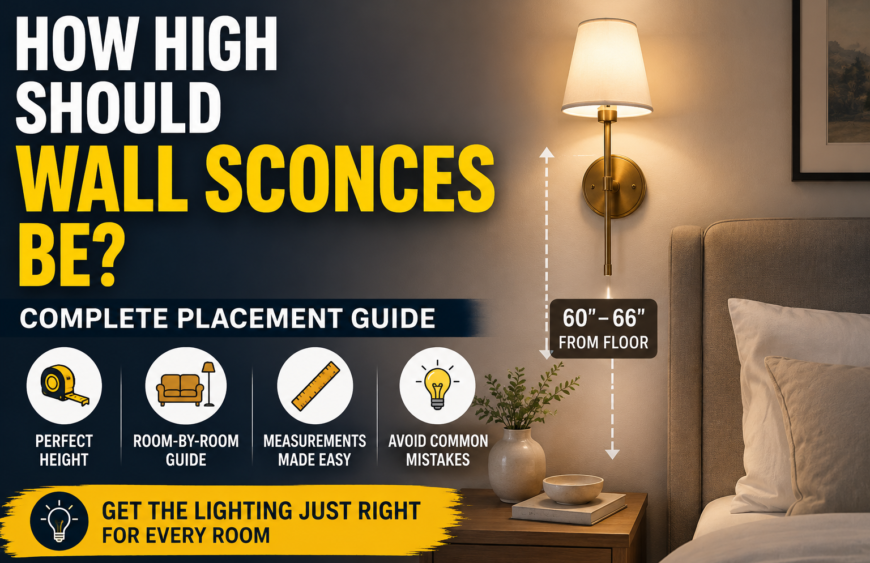
The standard wall sconce height is 60 to 66 inches from the finished floor to the center of the fixture for most rooms. This generally places the light at eye level for the average adult, preventing glare and ensuring even light distribution. However, this is a flexible rule. Bedroom sconces are often lower (30-36 inches above the mattress), while hallways and entryways may benefit from a taller mounting height of 66-72 inches.
Wall sconces are a powerful tool for adding ambiance, task lighting, and architectural interest to your home. However, their effectiveness hinges on proper placement. A poorly positioned sconce can cause glare, create unflattering shadows, and simply look “off” in the space. This comprehensive guide provides specific, actionable advice for installing wall sconces in every room of your home, ensuring they are both beautiful and functional.
Room-by-Room Wall Sconce Placement
The “perfect” height for a wall sconce depends on its purpose within a room. The following table provides a starting point for your project, but always consider the specific fixtures, ceiling height, and furniture in your space.
| Room | Starting Placement | Main Consideration |
|---|---|---|
| Bedroom (Bedside) | 30-36 inches above the top of the mattress | Aligns with shoulder height when sitting up in bed to provide comfortable reading light without glare. |
| Bathroom (Vanity) | 64-68 inches from the floor (when flanking mirror) | Illuminates the face evenly for grooming tasks without casting harsh shadows. Center should be at or slightly above eye level. |
| Hallway | 66-72 inches from the floor | Higher placement helps prevent glare and keeps the light out of the direct line of sight in narrow spaces, creating a guiding rhythm. |
| Living Room (General) | 60-66 inches from the floor | Acts as accent or ambient lighting. Placement is often dictated by seating or focal points like fireplaces and artwork. |
| Entryway | 66-72 inches from the floor | Welcoming guests with warm light that’s not overly glaring as they enter. Often used to frame a mirror or console table. |
| Dining Room | 66-72 inches from the floor | Softens the room’s corners and adds warmth. Should not visually compete with the main light source (like a chandelier). |
Furniture-Based Placement Guidelines
In rooms where furniture dictates usage, like the bedroom and living room, mounting height should be relative to the furniture, not just the floor. This ensures the light is where it’s needed most.
| Location | Placement Principle | Why It Matters |
|---|---|---|
| Above a Nightstand | Center of sconce 50-70 cm (20-28 in) above mattress | Provides task lighting for reading that falls directly onto a book or e-reader without creating glare. |
| Beside a Sofa | Mount 24-30 inches from the top of the sofa’s backrest | Creates comfortable, accessible light for reading or ambiance without being too high or too low. |
| Flanking a Mirror | Center 24-36 inches apart and at or slightly above eye level | Ensures even, shadow-free illumination for the face, which is crucial for bathroom mirrors. |
How to Determine the Ideal Height for Your Sconce
While starting points are helpful, here’s how to fine-tune your sconce placement for the best results.
How High Should Wall Sconces Be Above a Nightstand?
For bedside reading, sit up in bed against your headboard. The ideal height for a wall sconce is generally 6 to 12 inches above your shoulder, or about 30-36 inches above the mattress. The goal is to have the light source slightly above your eye line to prevent glare and direct light onto your reading material.
How to Prevent Glare
Glare is often caused by mounting a sconce too low or too high. The general rule is to keep the center of the light source at or slightly above eye level for the room’s primary activity. For instance, bathroom sconces flanking a mirror should be at eye level to illuminate the face, while in a hallway, a slightly higher placement (66-72 inches) keeps it out of the direct line of sight.
How to Test Placement Before Drilling
Once you have an idea of where you want the sconce, use painter’s tape to mark its outline on the wall. For a more realistic test, have a friend hold the sconce in the marked position at dusk or in the evening. Turn on the light and view it from different angles and positions in the room. This is the best way to see if the light will be functional and comfortable in real life.
How to Adjust Based on Ceiling Height and Fixture Size
While standard placement ranges from 60-66 inches from the floor, several factors can shift this starting point.
- Ceiling Height: In rooms with very high ceilings (e.g., over 10 feet), sconces may need to be mounted slightly higher to feel visually connected to the space. Conversely, in rooms with low ceilings, you might mount them lower.
- Fixture Size and Shape: A large, bulky sconce might feel overwhelming at the standard height, whereas a slender, vertical sconce could look lost. The best approach is to align the fixture’s center (or in the case of a tall sconce, its main light source) with eye level or the focal point. Sconces that direct light upward often look better when placed higher than the standard 60-66 inches.
- Furniture Height: For bedside sconces, the absolute rule is that the distance is measured from the mattress, not the floor. A bed with a thick, tall mattress will require a different floor-to-fixture measurement than a low-profile bed.
Common Wall Sconce Installation Mistakes to Avoid
- Mounting Too High or Too Low: A common mistake is installing sconces too high in an attempt to “get more light.” This often creates glare and makes the space feel unbalanced.
- Ignoring the “Eye-Level” Principle: A sconce that is not at or slightly above eye level for its intended purpose will often cause discomfort or shadows.
- Poor Spacing: In hallways, spacing sconces too far apart creates dark spots. The recommended spacing is generally 6 to 10 feet apart. For a pair of sconces flanking a bed or mirror, the horizontal distance between them is just as important as the vertical height; typically, they should be 24 to 36 inches apart.
- Placing Near a Corner or Door: Leave at least 6 inches of breathing room from any door frame, window, or corner.
- Choosing the Wrong Light Direction: Think about the path of the light. An upward-facing sconce near a ceiling is fine, but a down-facing sconce is better for reading or task lighting.
Hardwired vs. Plug-in and Battery-Powered Wall Lights
Choosing between a hardwired or plug-in/battery-powered sconce can significantly impact your installation options.
- Hardwired: Provides a seamless, built-in look. Requires access to electrical wiring in the wall and is a permanent installation that should be done by a licensed electrician.
- Plug-in (Battery or Electric): Offers maximum flexibility. Battery-powered wall lights are a perfect, renter-friendly solution that requires no wiring or an outlet. They can be placed anywhere with a secure wall surface and are ideal for renters or for those wanting to add lighting to a spot without existing electrical infrastructure. Plug-in electric sconces require a nearby outlet but also offer flexibility without the need for an electrician.
Step-by-Step Wall Sconce Installation
- Gather Your Tools: You will need a stud finder, level, pencil, measuring tape, drill, and appropriate drill bits.
- Plan and Mark: Determine the ideal height and horizontal position based on the guidelines above. Mark the spot for the center of your backplate with a pencil.
- Test the Position: Use painter’s tape to create a life-sized mock-up of the sconce on the wall.
- Check for Studs: Use a stud finder to locate a wall stud. It is ideal to mount the backplate directly to a stud for maximum support.
- Install the Mounting Bracket: Hold the sconce’s mounting bracket against the wall where you want it and use a level to ensure it’s straight. Mark the screw holes with a pencil. Pre-drill holes (if not drilling into a stud, use wall anchors). Secure the mounting bracket to the wall.
- Connect the Wires (Hardwired Only): For a hardwired installation, carefully follow the manufacturer’s instructions to connect the fixture’s wires to the electrical box’s wires (typically black to black, white to white, and ground to ground). Secure wire connections with wire nuts.
- Attach the Fixture: Attach the sconce to the mounting bracket following the manufacturer’s instructions, often by securing it with small screws.
- Install the Bulb: Screw in the recommended bulb. Ensure you are using the correct wattage and bulb type (e.g., LED) as specified in the product details.
- Test and Enjoy: Turn on the power or activate the switch to ensure the sconce functions as expected. For battery-operated lights, insert the batteries and test the unit.
Frequently Asked Questions
What is the standard height for a wall sconce?
The most common recommendation is 60 to 66 inches from the floor to the center of the fixture for general ambient and accent lighting.
How high should bedroom wall sconces be?
For bedside reading, a good rule is to mount them 30-36 inches above the top of the mattress.
How high should bathroom vanity sconces be?
When flanking a mirror, mount the sconces about 64-68 inches from the floor to the center, which aligns with or is slightly above average eye level.
How high should wall sconces be in a hallway?
To prevent glare in a narrow space, a recommended height is 66 to 72 inches from the floor.
How far apart should wall sconces be?
In hallways, place them about 6-10 feet apart. When using a pair to flank a bed or mirror, position them 24-36 inches apart.
Are battery-powered wall sconces a good option?
Yes, they are an excellent choice for renters or for homeowners who want to add lighting without the hassle and cost of hardwiring. They offer maximum flexibility in placement.
How high should sconces be above a nightstand?
The standard recommendation is 50-70 cm (20-28 inches) above the mattress, ensuring the light falls onto a book without glare when you are sitting up in bed.
How high should sconces be beside a sofa?
Mount them about 24-30 inches from the top of the sofa’s backrest to create comfortable reading light without glare.
How does ceiling height affect sconce placement?
For very high ceilings (over 10 feet), you might need to mount the sconce higher than the standard range. With low ceilings, you may need to mount it lower. The goal is always visual and functional balance.
Should wall sconces be at eye level?
Yes, for most living spaces and when flanking a vanity mirror. At or slightly above eye level prevents glare and ensures even light distribution.